Kevin Spacey – Clarence Darrow :: Old Vic Theatre, London :: 4-6-2014
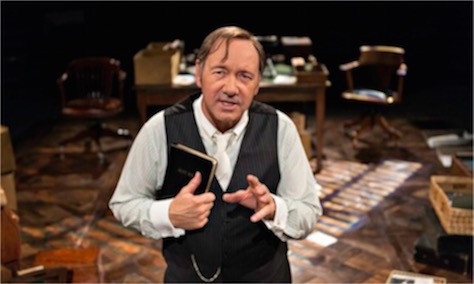
Photo Credit: Manuel Harlan for The Guardian
“I am pleading for the future… when hatred and cruelty will not control our hearts, when we can learn that all life is worth saving; that mercy is the highest attribute of man.”
For an actor, assuming you’re not one of the out-of-work ones (rare itself), there’s a certain career path that has been well-trodden over the last half century, since the end of the studio system and the exclusivity contracts given to their stables of stars. The early fight for supporting roles, the toil through endless auditions, catching the eye in average movies, which lets you move onto the next rung, then perhaps getting a decent agent, and then even more supporting roles but maybe in better movies. Depending on what you look like, you could make it to the part of the best friend or love interest, though it would actually be better to be unusual or even average looking, because only then might the parts get interesting. Perhaps you’ll pull the supporting role of a lifetime, the unlikely hero or the revealed villain, and steal the movie. You can succeed because it’s been pre-decided, due to your non-Jackman/Pitt/Cruise level looks, that you’re not the leading man, but you’re eye-catching enough to form important connections with people who’ll stand up for you when the studio wants someone more traditionally handsome for their next Oscar-bait drama: the kind that Hollywood used to make, until fairly recently. This path was largely unaltered until around fifteen years ago, when a shift started to happen in the mainstream movie business. The Hollywood paymasters shoved real creatives toward the margins and even the smaller movies started to be made by committee. The approach itself wasn’t new but the players were. Marketing executives with an eye on toy markets, merchandising, one-sheets, TV spots and sequels were now sending notes back on scripts – these people had not a clue on earth what components a film needed to be good. They used to come in after a movie was made, with no part played in the creative process, but it all changed and getting great writing onto the big screen suddenly became as easy as pushing water up a hill.
Disillusioned creatives saw this commerce, rather than arts, driven approach becoming the new normal and started to do something drastic and unprecedented – they moved to TV. Before, TV had been the last refuge of the failed movie actor. There’s a lot to be said for a steady paycheck. The first stirrings were seen as the century ended, with the 1999 premieres of both The West Wing on broadcast (the channels everyone gets) and The Sopranos on cable, (which you pay for, in the US model). Bit by bit, the best actors started dropping out of movies and into TV, because that’s where the great dramas were now being made. They ran away from the comic book adaptations, the tent-pole summer blockbusters and the sequels, perhaps indulging in a little voice acting for animations to top up the bank balance. Some rushed straight into TV, while others rushed straight to the stage. A few were clever enough to do everything: take a good part in a small movie for a nice wage when the script was good enough, focus on theatre and help to get plays on not just by starring in them but by producing them, and finally, only when the absolutely perfect part came along, created by none of the established cable networks (operating outside even HBO/AMC/Showtime et al. without any constraints, the newest players are Netflix, Hulu and Amazon: with no track record comes no fear, nor limits on adventure or investment), jump on it and create a career where half the year is spent doing a remarkable TV show and the other half is spent with theatre sawdust in the nostrils. This is how to conduct a career, be in charge of it, while taking or creating the best opportunities. And thus, we come to Kevin Spacey.
Put simply, eleven years ago he opted out of Hollywood, at a time when his star was sky high and $10m a movie was on the table. He saw that great movie drama was in trouble but wasn’t quite ready to be on the small screen. So he moved to London and became the artistic director of the Old Vic Theatre in Waterloo. Many thought this was some vanity project. A chance to use his name to act in a series of revivals and just get as many eyeballs on him as possible. That may be the perception, but the facts don’t bear it out: since 2003, he has directed only two plays and starred in seven (his last being 2011’s acclaimed Richard III, which saw a reunion with Sam Mendes), but has shepherded over forty onto the stage, by focusing his not inconsiderable reserves of personal charm onto fundraising and creative partnerships. While the Old Vic, at nearly 200 years of age, wasn’t quite the busted flush that some of the media suggested pre-Spacey’s arrival, he has turned it into a theatre that can attract the newest and most exciting plays, to rival the National Theatre (which once controlled it). His aim was not just to reinvigorate the place, but also to create a structure and innovative ethos that would allow it to continue long after he abdicated. Next year he will hand over to Matthew Warchus, whose credentials catch the eye; most recently, he directed the magical Matilda musical, which won seven Oliviers and five Tonys last year.
Darrow has been called a civil rights lawyer, but this is an oversimplification. He defended murderers threatened with the death penalty to prevent the state from committing another display of dehumanising horror themselves, arguing that mercy is what makes society better, and how revenge will only make us harder people. He proudly saved 102 people from death row. Humanity’s good aims interested him more than America’s often Biblically inspired desire for revenge; he believed in trying to pry out people’s innate goodness. But more than this, his philosophy was to fight for the common man and woman. A full forty years before the turning point of the civil rights battle he lined up behind black defendants faced with all-white juries. The most celebrated case of this type was that of Ossian Sweet, a black doctor who had the temerity to move into a white neighbourhood. His home was surrounded by an angry mob and, as they advanced to his door, a shot was fired that killed one of the invaders. In many US states this would be allowed under the so-called ‘stand your ground’ law, sadly now used to free killers like George Zimmerman. Darrow defended Sweet and, in a landmark case, he was acquitted of murder.
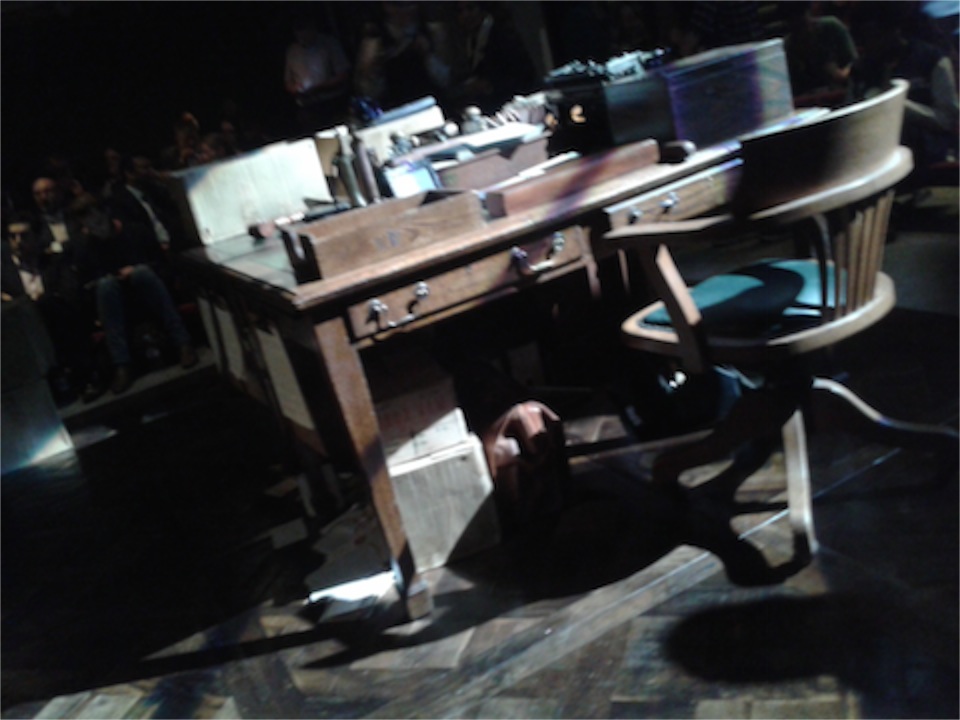
The text of the play itself, written by David W. Rintels (based on the biography Clarence Darrow For The Defense by Irving Stone, who also wrote the famed van Gogh bio Lust For Life) and first performed by Henry Fonda in 1974, is fairly straightforward. It’s an autobiographical run through of Darrow’s most famed cases, after first illuminating his Ohio upbringing, to freethinking parents: his mother talked of suffrage in 1840, no less than 80 years before women gained countrywide voting rights. It briefly covers his move to Chicago, his first marriage, and even a little of the unfounded jury bribery allegations that beset him during the case of the McNamara brothers, who had planted a bomb in the offices of the Los Angeles Times during a labour union dispute: not intending to harm anyone, they had killed 21 newspaper employees; Darrow saved them from the noose. He defended Pennsylvania miners, who were working fourteen hours a day, 365 days a year, against their bosses, arguing for better pay and working conditions. Spacey made the audience gasp with a tale of an 11-year-old child miner who had a leg amputated due to employer negligence: he was manipulative in the way that all great arguers are. A champion of the unions, no doubt the right-wing would today call him a Communist. He never even claimed to be a socialist; he was simply a man who wanted to use his intellect and talents to stand up for the underdog. He was an inspiration to anyone who wants to speak for the vulnerable. He didn’t mind a bit of media-bait either, perhaps best encapsulated in the Scopes ‘monkey’ trial, following a schoolteacher’s prosecution for teaching evolution in the Bible Belt. The play finishes, inevitably, to a coruscating powerhouse denouement on perhaps Darrow’s most famous case, that of Leopold and Loeb, two rich teenagers who killed a 14-year-old boy merely for the experience and excitement, the challenge of getting away with it. This is where the concept of mercy came in, as Darrow fervently believed that we can only move forward as a collective culture when we reject the baser instincts of our human nature. He believed without pause in rehabilitation over retribution as a model for how a civilised society should behave.
Spacey had played Darrow no less than twice before. When pressed, he has said that the first occasion, a 1991 low budget PBS movie, was his favourite filming experience. The second time was in a 2009 Old Vic production of Inherit The Wind, (with the Darrow character alternately named Henry Drummond). He is the fourth fine actor to play the role: after Fonda, Orson Welles took him on in 1959’s Compulsion, a thinly fictionalised account of the Leopold and Loeb trial; perhaps the most famous incarnation was in the film adaptation of Inherit The Wind, with Spencer Tracy’s Oscar nominated version taking the plaudits.
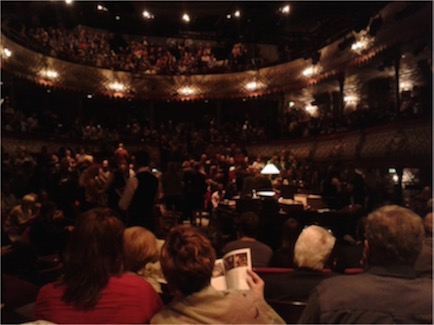
A one-man (or woman) show is not to be trifled with, and few actors on earth could hold the rapt attention of a thousand people the way Spacey does. Once I got over the initial thrill of seeing such a renowned actor in person, and only a few feet away, it was an easy pleasure to get swept away in the invective and the complete command and control he has over an audience. It’s not just his level of stagecraft and experience, which is considerable (I’d seen him once before, unashamedly scene-stealing in The Philadelphia Story in this same venue) – it’s the sheer force of his charismatic presence. This is an actor at his absolute career peak, both in person and on screen. In his other job, House of Cards, he gives you barely a drip of humanity, and yet still you root for his Machiavellian politician. Such is his skill that he can strip away any remaining vestige of humanity, as in Se7en, and leave you disgusted but in awe. He can project a seductive quality, as in LA Confidential, or pathetic desperation, as in American Beauty. He can scenery-chew for a giggle, as in the otherwise unwatchable Superman Returns, or con you completely, in The Usual Suspects. He even stood up to his mentor Jack Lemmon, perhaps the actor he resembles the most in the cinema canon, in Glengarry Glen Ross. During the second half, I heard an anachronistic noise: it became clear that a mobile phone was going off (idiots are present everywhere) and, in character, without breaking a beat, he said ‘If you don’t answer that, I will.’ Everything appears to be effortless, which is as it should be when you work as hard as Spacey does.
Perhaps the only cautionary tale is that we should now be able to view Darrow’s humanitarianism as quaint, a relic of a more closed-minded century. Unfortunately, the world is no less right-wing (it just seems like it is because we talk more; activism is higher but pushback is greater) than it was during his heyday. While some progress has been made, governments are more secretive and still as keen to crush uprisings (for example, in the last year 40,000 protestors have been jailed in Egypt, with all forms of protest now banned by a government elected as a result of protests), while citizens are more suspicious, and rightly so given the inroads made on liberties and how much we are spied on daily. The game is rigged, with little advances made in social justice and minority interest groups dominating the conversation (belief in climate change is crazy and anti-business while belief in invisible gods is sky high). What is the internet itself, except a method from which data is collected on behaviours, and how long before it’s yanked under corporate control and net neutrality becomes a thing of the past? Most of the jail populations still come from backgrounds of poverty and poor education, while education funding itself is slashed and healthcare is sold to the highest bidder. He should be a winner on the right side of history, not an anomaly pushing against the tide. A century later, we need fighters like Darrow more than ever.
...
Janelle Monáe :: Brixton Academy, London :: 9-5-14
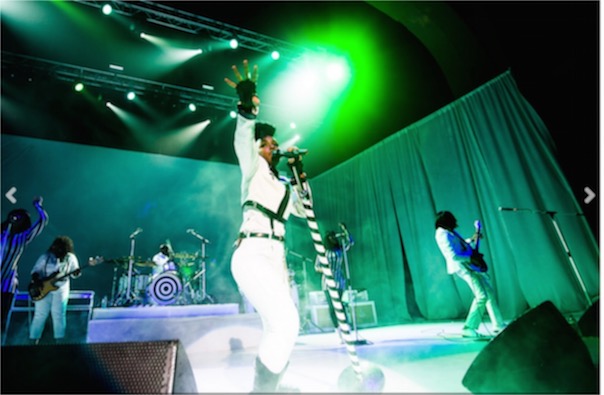
photo by Jason Williamson
During a conversation about a hundred (ok, 5-10) years ago on BowieNet a friend of mine opined on Prince, exclaiming that he was like a walking Black History Month. He absorbed the best bits of those he had loved, watched and learned from. But while his influences were worn openly, he was completely himself. For the guitar, and the hotness which shouldn’t work but somehow does, he took plenty of Hendrix (though a much more conservative version). For the weirdness and sense of innovation he took some George Clinton. For the dictatorial bandleader, to channel the funk that poured out of him, he took so much from Sly Stone. For the overall king of everything, master of all, he stole liberally from James Brown. For the fuck you attitude it was all Miles Davis. And only recently, I realised, for the slices of sweeter soul he nicked a ton from Shuggie Otis. This is Prince. The parts that make him who he is. The people through which he is filtered. Everyone in music has this, the family tree that created them. But few are as blatant as Prince, and few have been so transparent, until I saw Janelle Monáe perform.
This is no bad thing, and I don’t wish to make it appear so. She does have a bit of an authenticity problem, because stealing without filtering and reimagining is just you doing an impersonation of someone else and I don’t think she needs to do that. This was never demonstrated better than during the two ‘tribute’ sections in the show. The second, during the encore, was a little much, a fairly karaoke-ish version of Let’s Go Crazy. It was perhaps only present as a nod because Prince appears briefly on Givin Em What They Love, from her most recent album, last year’s The Electric Lady, hands down my favourite pop record of 2013 (imagine a lost album located between Off The Wall and Lovesexy, you’re nearly there; in a pop-world of single digital downloads, she made a real no-filler long player). It was fine; it wasn’t bad, but the show just didn’t need it. She had half a dozen of her own songs she hadn’t played yet – like the remarkable Victory, which sadly wasn’t played at all. There’s really no need to do covers when you have the songs, though I understood why she felt the need to pay tribute.
Some time before that, and this one hit the sweet spot with me because he was my first childhood music love, she did a perfectly weighted Jackson Five homage (I Want You Back /ABC). If you shut your eyes, it was like listening to a note-perfect teenage Michael Jackson. No kidding, she nailed the shit out of a pair of songs she has obviously been singing all her life. So when I say that Prince synthesises all of his musical loves yet manages to create something wholly original, I don’t think Janelle Monáe is quite there yet. But, and this is the crucial part, because her songwriting is so fantastic and her songs are so incredibly perfect, none of her reliance on being derivative matters.
My best friend and gig-going companion suggested that her robotic persona is misdirection, as since the start she has adopted, Bowie-like, the persona of a character called Cindi Mayweather. Incidentally, she says that she hasn’t yet talked to Bowie but that he’s in her subconscious and they speak ‘on the same frequencies', which is a little bit nutty, a good sign (she also says there’s a time travel machine in Atlanta that both she and OutKast have been through, and I feel like I could believe her). We mused on whether she does the whole I’m-an-android thing because she’s a bit, how to put it, stiff? She can be a little halting in her performance, without the emotional warmth of other R&B divas, but that this is covered by the sheer amount of hard work she gets through onstage, dancing both brilliantly and a bit awkwardly without pause. I was exhausted just watching her. Or does she do it because she wants to put up a big wall and not convey any of the over-personal I’m-really-your-mate nonsense of the Rihannas and the Mileys? I actually love that about her, how little I know about her personally, in this age of over-sharing. I don’t know what she wears when she’s offstage. I don’t know where she lives or what her house looks like. I don’t know whether she drinks or smokes or takes drugs. I don’t know who she sleeps with or who she hangs out with. I know nothing about her at all, except that, somehow fittingly, as she does have a kind of Dorothy innocence, that she’s from Kansas, aka the Land of Oz (incidentally, someone should remake The Wiz: she could play all of the parts). She talks about being an android, though certainly, Data-like, she seems to be trying to be more human. It’s a clever and unique approach.
So for example, the android Janelle has spent years watching Michael Jackson on repeat and has synthesised and then replicated his moves, and the showman inside lets it out; to the delight of the audience she moonwalks several times. Not just Michael either, there was more than a little of Rhythm Nation Janet present in the room as well. How many members of the audience get all of these references? It doesn’t matter. Maybe the kids swooning over her will look something up on You Tube when they get home, find some old clips and see from whence it all came. I must admit, I couldn’t help but smile at the overwhelming amount of James Brown-isms on show: the boxing-style warm-up man, the announcer, reminiscent of Danny Ray, who stirred JB crowds into a frenzy for over 30 years. Then we had the foot-to-foot shuffle and the mic stand being flipped back and forth, which are now third generation moves. I am always reminded of that precocious MJ clip, recorded in July 1968 (a month before his 10th birthday, he’d already been performing on stage for 4 years), covering JB’s I Got The Feelin, for their Motown audition tape. And now she steals from MJ, who stole from JB, so she’s lauding both and those same moves are passed down across 50 years. And finally there was the announcer coming on to put a velvet robe around her shoulders, which she would then throw off, another JB steal. It was utterly shameless and I loved every second of it.
I have rarely heard such perfectly appointed pop music, conveyed so meticulously, both calculated and heartfelt. And she doesn’t have to do what all of the other female artists seem to think they need to do, or are told to do by fat white guys at their record labels. It’s a little sad that this must be stated as news but she doesn’t use sex to sell her music. Shocking! She has a simple but slick visual theme that doesn’t exploit anyone and she sticks to it to the last: enveloped in a big white backdrop, alongside her tight 7-piece band, who are dressed in black and white and play black or white instruments, and her two black and white stripe-clad backing singers, she wears a uniform of black and white – tight white trousers, white shirt, bolero jacket, black braces and with her hair in a high pompadour (this time, a steal from both JB and Little Richard). There’s no short skirts or cleavage or sliding down a pole happening. There are a few instances of crotch thrusting but it comes off in a non-sexual way, somehow (to be fair, it wasn’t exactly arousing when MJ did it either). She’s not Beyoncé, who with the raising of one eyebrow and the slight movement of one thigh can exude sex all day long, but she does have a Beyoncé-like control over her creative output (without, one hopes, the slightly creepy temperature-controlled digital storage facility recording her every move). She seems to be in complete control, without having to expose her flesh, and has surrounded herself with an intelligent, creative team – from her excellent band to OutKast’s Big Boi as producer to collaborators such as Erykah Badu, Solange and Esperanza Spalding, who are, in no coincidence, also powerful women in control of their careers.
But the songs, it’s all about those songs: Dance Apocalyptic, Q.U.E.E.N., Electric Lady, Come Alive and the big hit from the first record, Tightrope. In truth, the encore of Many Moons dragged a little, turning into a 10-minute band introduction song that descended into her lying on stage before being ‘revived’, Frankenstein-style, by bolts of lightning. It probably looked great from the front row, not least when she finished the show with a spot of crowd surfing, but at the back it caused people to start checking their phones. That minor quibble aside, from the second the gig started with her being carried on stage in a straitjacket, after no less than three men in white delivered and polished her black and white striped microphone stand, this was a devastating, energetic, brilliant pitch-perfect performance of flawless pop music in front of a baying, buzzing crowd. It was a thrill to be there.
A perfect storm: everyday sexism and females who like football :: 4-5-2014
Football is a game for men. They play it, they run it, they attend it. The few women working in football are often marginalised, patronised, ignored, abused and/or disrespected on a daily basis. Women do actually play football as well but nobody really cares. When the England team are on TV the BBC broadcast (it’s always the BBC – a commercial channel would never put it on because they can’t make money from women playing football) is treated with the same respect as men’s games but the stadium is usually half-empty, even for a World Cup qualifier. The attendees are families and local schoolchildren: the straight, white men with season tickets across the land, who turn out in their millions to watch the nation’s favourite sport every week, largely do not attend and are not interested in doing so. Before Hillsborough, women rarely attended football matches. The all-standing terraces were not a welcoming place, unless you wanted to be pressed up against male strangers. Children were taken, but only boys of course. After the Taylor Report was published, post-Hillsborough, which recommended all-seater stadia in order to avoid such a tragedy recurring, gradually women started to attend matches.
According to these 2009 figures, 19% of Premier League attendees are women. It feels like less when I go, I must say, perhaps because I mostly go to away games. It feels like a few dozen women and about 2000 men but being entirely outnumbered doesn’t remotely enter my head when I go to a match. It’s just the way it is when you’re female and you love football. However, a cursory Google search of women + football brings unsurprisingly depressing results – reams of articles, blogs and message board posts on why women don’t like it, don’t understand it, are not welcome at it and so on. Largely, football is something that men both watch and do. And they want to do it with each other, oblivious to its homoeroticism of course (oh the irony of worshipping its perfectly coiffed, manscaped, buffed, vain and sculpted players, who kiss and cuddle each other frequently), and they do not want women there. It used to be the one place where they could escape from the nagging shrews and harpies they married. The women who won’t shut up. The women who are interested only in shopping and spending the money their men earn. Yes, the universe of football still exists in the 1950s. The spouse of a football player who dares to publicly express her opinion about where he should live, who he should play for, what city they should live in and what schools they should send their children to are called gold-digging slags who should shut up and take their husband’s money. Sadly, most of the women that surround footballers, the famed WAGs, are perma-tanned, pneumatic airheads; though a few are the childhood sweetheart type, the girl next door who doesn’t like football anyway. Bagging a footballer – either as a husband so these women don’t have to work or so they can sell a tabloid tale – is a commonplace sport in itself in nightclubs up and down the land every weekend and women like that are not helping themselves or the rest of us. However, the notion that not all women are the same is an alien concept to men who resent having their personal football space invaded. Virgin, mother or whore: the three eternal categories into which we all fall, right? The spectre of women attending, watching or speaking about football is largely unwelcome and any woman who likes football has an endless supply of tales to tell about being disrespected by men.
My own experience of this, until yesterday, was rather typical. Before the days of watching online, I might have gone to pubs to watch my beloved Manchester City. I would chat happily with non-City supporters about the game. More often than not they would express surprise that I knew so much, or anything I suppose, about the sport, beyond liking fit players and their thighs, which is what women who like football are supposed to comment on or care about. Recently on holiday in Rome, a taxi driver expressed shocked bemusement that I knew anything about football or even liked it at all. Musings on what life is like for female football fans outside the UK are for another time. It’s difficult to be a black man playing football on the continent, so let’s not even wonder about what it might be like to be a female in football’s general area.
On non-football message boards I have over the years encountered fairly tame comments that men think are funny (sometimes they are, if from the right person) telling me to get back in the kitchen and stop watching the match because women don’t even understand the offside rule (that old chestnut), let alone the intricacies of tactics, team selection, transfer windows, zonal marking systems, high line defences and how goalkeepers should cover their angles. I’m used to being disrespected, constantly. However, I should mention that this treatment has never, not even once, been meted out to me by my own people, by other City fans, either in pubs or at our games. We’re all in it together and the men who have sat either side of me at the matches I’ve been attending for over 25 of my 37 years could not give any sort of shit about whether I’m female or not. I shout at an underperforming player the same as them. I cheer the same as them. I bite my nails just as much as them. We cry together and we celebrate together.
About two weeks ago, I read this story. TalkSport is a radio station, fairly well respected, but its website is not something I have any knowledge of. If a rumour appears on a website I tend to pay no attention. If it appears on a broadsheet newspaper’s website I will certainly pay attention. And if it appears on the BBC it is true. That’s how it goes. So that story, about Manchester City’s brilliant keeper, England’s number 1, Joe Hart being swapped in the summer for Tottenham Hotspur’s French goalie Hugo Lloris received a little attention, though not as much as if it had been reported on a respected website. I don’t think Lloris is very good. At the Crystal Palace game last week, which I attended, the City fans made their feelings known about the article. It was good-natured, a tune of support to ‘super Joey Hart’ (comically, sung to the tune of Achy Breaky Heart!), with an ending salvo of ‘if you sell him you’ll have a fucking riot on your hands!’ The report seemed ridiculous. We have one of the best goalkeepers in Europe and if he ever did leave he’d go to a team in the Champions League anyway. Spurs aren’t a bad team at all, I should say. They’re top 6 and have their moments of brilliance. This season, however, they’ve had a bit of a disaster. They keep switching managers (in fact, they’ve had 6 in 10 years, an approach which my own club are also guilty of) and had to sell their best player for £100 million but then pissed away the money on seven very average players (far too many to integrate into a squad at once and only one, Eriksen, looks any good at all). Their last manager was fired partly because of those transfer failures but mostly for presiding over some poor results and their current manager has recently had to comment on the club talking to other managers behind his back. They’re not in great shape, but they’re still one of the best teams in the country.
City and Spurs have some previous, going back decades – football fans have long memories, as often that’s all we have. There’s no love lost between the clubs. And while this is technically off-topic, I find the section of their fans who revel in chanting anti-semitic hate speech to be worthy of only my contempt. If the few Jews at White Hart Lane want to chant Yid Army, incidentally, that’s fine by me. It’s the non-Jews chanting it that I object to. It ain’t their word to reclaim… imagine if I’d told the Twitter hordes I was an actual yid, as well as being a female with an opinion, yesterday. I shudder to think of what might have transpired. But I’m getting ahead of myself.
We’ve played them twice this season. They came to our place in November and got pasted 6-0. Lloris was responsible, as you can see here, for two of the goals through egregious errors. We went to their place at the end of January, tore them to shreds and won 5-1. Just before then, on New Year’s Day, I sat with my uncle and dad and we watched Spurs play at Old Trafford. Incredibly, they won 2-1, but with no thanks to Lloris, whose blunders nearly cost them the game. The three of us laughed at him throughout, remarking on what a poor keeper he was. Since then, he’s improved and hasn’t made any really big mistakes for a couple of months. He is a truly fantastic shot-stopper and can make wonderful saves when called upon. But that is only a part of the goalkeeper’s job – he must anticipate attacking danger, be ready for it; he must come out to get high balls, or stay back if he can’t get there; he must come for corners if he can, or know when he can’t; he must give confidence to the defence in front of him and set them up correctly (following the manager’s instructions); he must make sure the wall in front of him for free kicks is exactly where it needs to be so they can cover one side of the goal while he covers the other. And so on and on. Simply stopping a fired shot is only one part of the job and Lloris is excellent at that, but he’s not that great at a fair amount of the other stuff. Of course, I do not watch Spurs every week. I only watch my own team every week. So I will defer to the knowledge of any fan over my own regarding their own team. While I only watch Spurs in highlights packages (though I have seen perhaps 10 of their games in entirety this season), I’ve not been very impressed with Lloris. He is not physically imposing, he comes off his line obsessively quickly and often wrongly, he parries shots in front and has let goals in because he failed to turn a shot around the post. For example, he failed to arrange his wall properly yesterday and caused Spurs to concede a second, crucial, goal away at West Ham, though arguably that’s the fault of the gutless Paulinho and (here’s a surprise) Adebayor.
During the game I posted, as I have done many times, a Tweet that I hashtagged to #bbcfootball. I’d never had a Tweet chosen before for their football updates page, which is viewed by millions of people. It said:
Lloris, like most keepers, is a good shot-stopper. But he's truly a dreadful all-round keeper! Worst in the PL by a long way. #bbcfootball
And then I went to make my lunch. Of course, he’s probably not the worst Premier League keeper. That was a bit of hyperbole! The rest is something I believe. I came back from the kitchen and that’s when it started. A Favourited Tweet. A Retweet. And then another, and then another. I thought, oh my, the Beeb must have put it up, how exciting! I checked the page and, sure enough, they had, with a live link to my Twitter page. My excitement was short-lived.
Soon a trickle of Retweets turned into a stream of profane and abusive replies, the like of which I’d only read about women receiving for suggesting, how dare they, that a woman should be on a £20 note or something. It soon overwhelmed my email and Twitter page. Comment after comment after comment. Here are the best ones (and you will notice the word yid in several of their usernames):

And here’s one apology from a sane person.

I replied to a few of the non-idiot respondents and we had a nice chat about football. I ignored the trolls (you can’t engage with crazy, nothing good ever comes of it). By the end I had 26 Retweets – all of which had been made by furious Spurs fans to other fans and forums so more people could see it and visit my page to abuse me. The respondents were 99% male. 95% of the comments were abusive. My heart was thumping as it was all happening. After two very long hours it had all calmed down and, fortunately, did not reach the levels of rape and/or death threats that so many women have had to tolerate.
So here’s the thing. Every week people say mean things about my team. Every single week, and often on that very BBC Football page. Awful things. I have never sought out anyone who has said terrible things about my club or my players. What would I do that for? What purpose would it serve to start an argument with a stranger? I love, I LOVE, a good argument and I’m pretty good at it. Perhaps when I was younger I was more likely to lose my temper (I do have a bit of a temper) at someone saying something stupid. But now… unless it’s something really out of order (like a racist attack on a player, a bigoted comment, that type of thing) I won’t weigh in. And I certainly wouldn’t have a go at a stranger on Twitter, the world’s toilet wall.
How can people be riled to the point where they felt they needed to click on my Twitter link and head over there to call me names? Would they do it in real life? If I’d been sitting in a pub and had said to a Spurs fan that Lloris was poor would they have smashed a glass in my face? Probably not. If I were male would that abuse have happened in that form anyway? Certainly not. A football fan can often be rational if engaged one-on-one. But en masse, it takes very little to turn what I hope are usually reasonable people into an incited, angry, hateful mob, either online or at a match. The power of numbers. And in this particular case, the power of numbers plus anonymity. There’s something about collective anger multiplied by mob mentality that allows the anonymous nature of the internet to amplify people’s darkest sides. I don’t mind Spurs fans telling me that I’m simply wrong and that Lloris is a great keeper, that’s fine (and when you’re told by 50+ people that you’re wrong about a player’s qualities you can’t help but doubt what you thought in the first place). He’s their keeper, not mine, I don’t have to like or care about him and how he plays. I’m glad they like him, good for them. But who am I to a Spurs fan? Absolutely nobody. Why does my opinion matter at all? Why take the time to come over to my Twitter page and its 116 followers and tell me that I should go back into the kitchen, where women belong? Why are men so obsessed with women being in kitchens anyway? If only they knew about my terrible cooking and lack of interest in anything remotely domestic.
To elicit such venom from strangers is a most bizarre thing to be on the receiving end of. I’m sure the BBC don’t care (but did know) that posting my comment would have caused angered responses. I don’t think my Tweet was incendiary; it’s not like I said he’s a dirty frog who fucks his sister or something, in which case any abuse coming my way would be justified. I would have been happy to further explain what I meant by the comment in calm tones, but the internet, and Twitter in particular, doesn’t work like that. I didn’t think the BBC would put my fairly flippant Tweet (all of my Tweets are frivolous really) on their page. I didn’t think much about it at all in fact when I posted it. I certainly didn’t think it’d cause me to become an online hate figure and punching bag during an afternoon that I wanted to go quickly while waiting for an important City game to start. While it was going on I called my dad and he unhelpfully said that I should stop Tweeting at all. He was supremely stressed about the Everton game and we’ve talked about it since, he realises now how upsetting it all was for me. But really, why would he understand? He has never been attacked or devalued or discriminated against because of his gender. He has never been told, nor will he ever be told, that he doesn’t know what he’s talking about because he’s a man.
Incidentally, I have never been told that I don’t know what I’m talking about because I’m female on any subject other than football and nor would I be. Because if I express an opinion about, for example, a form of media – a book or film or piece of music or concert – or a thesis or a piece of marketing collateral I’m not responded to in that way. I’m actually paid every day (knock on wood) to give my opinions, it’s how I make a living, such as it is. This only happens in sport. And while I can only speak for football I’ll wager my music collection that the same shit happens to women who like American NFL or hockey or rugby or basketball or any other male-dominated sport where men are (straight) men and women are not welcome. And what we face in sport is, of course, just a sliver, a thimble, a tiny little almost non-existent fraction of the daily horror that men subject women to.
The people who abused me online yesterday will have forgotten about it almost instantly, I’m sure of that. Today they’ll forget that they called a complete stranger a fucking bitch and a mong and a retard. They’re just normal people, who love their team and go to work and make their dinner and live their lives and happened to take umbrage against something a girl said about a goalkeeper. The internet, as a mechanism of communication, goads people to behave like animals on a daily basis. They didn’t like what I said and they sought me out to tell me so, but not in normal terms like a person would if they knew me and disagreed with me (like the friends I have who support Spurs might) because they don’t know me at all. It was precisely because they didn’t know me that they lashed out.
This is where we are now; the facelessness of the online world has fostered a basic lack of humanity, whereby we’re all connected and yet we’re further away from kindness, understanding, respect for others’ opinions and acceptable social behaviour than ever. Where how much men truly hate women can be venomously expressed with a few typed words and a mouse click without anyone being identified or held to account. The internet is meant to connect us and often it does. It’s certainly changed my life for the better and continues to do so. It is a wondrous thing and I am not only grateful it exists but feel privileged to have witnessed it be created, adopted and affect worldwide change beyond estimation. Yet more often than not it creates worlds where, without face-to-face interaction, any remnant of humanity is absent. The world really is moving too fast for some people.
...
What do you do when your club becomes the richest in the world?
The other week I went to Upton Park to see my beloved Manchester City play West Ham in the second leg of the Capital One Cup semi-final. I had asked for the ticket (I’m a member of the Supporters’ Club, a benefit is requesting tickets) before we won the first match 6-0 but I grab any chance I can to see my team – having moved to London in 2000, away games are pretty much my only chance to see us play. I average a home game a season (this time it’ll be Fulham in March) when I go home to visit but away matches are rather unique. It’s a constantly singing, buzzing, boiling cauldron of intensity. It’s not like that at home, where the size of the stadium dissipates the noise – away fans are the real deal, a devoted band of travellers who follow the team home and away, across not just England but Europe (to think of the days when we were a million miles away from even playing in the Europa, let alone the Champions League). It ain’t cheap (£50+ a ticket – when I moved here it was £35; better team now, they charge fans more: so the club is rich, we are too?) but I can’t complain as most of the away fans have come down from Manchester, and the costs in entirety must be astronomical. Mind you, there are a few ex-pats like me, and I even meet fans from London and the south who started supporting us decades ago (why, I wonder, what did we have to offer then?! I inherited City from my dad, and he from his, whereas they picked us quite randomly).
The vibe at Upton Park was unlike any I’d experienced because of the bizarre scoreline (already 6-0) before we even kicked off. It was an odd atmosphere, with us virtually certain of getting to the final. I’m usually a bag of nerves and stress, as you’d expect, but here we were, one professional display away from our first League Cup (as opposed to FA Cup) appearance since 1976, the year of my birth.
Near the end a bad tackle, ludicrously unpunished by the referee, brought down our new Spanish striker, a complete player if ever I saw one, Alvaro Negredo. He fell very awkwardly and grabbed his shoulder in agony. Anger at the non-award of the free kick fell away quickly, to be replaced with genuine concern, as fans held their heads and covered their mouths in hope that he’d be ok. At worst, it could be a dislocated shoulder, we all thought. The medical team attended to him and he went back on, holding his arm, refusing to go off the field for the last 5 minutes. Tough lad, that one (he left the stadium later with his arm in a sling). Then, the sound of what a TV audience must think is booing filled the night air. In fact, it was the low hum of the City fans chanting his nickname: Beast. In Spain he had come to be known as La fiera de Vallecas: the beast of Vallecas (a tough, working-class Madrid neighbourhood where he grew up). Certainly, some of the worry was about the possible loss of such a fantastic player to injury but mostly it was of simple concern that a person was hurt. It made me think about what these men mean to me, and it’s why I chose to write this blog.
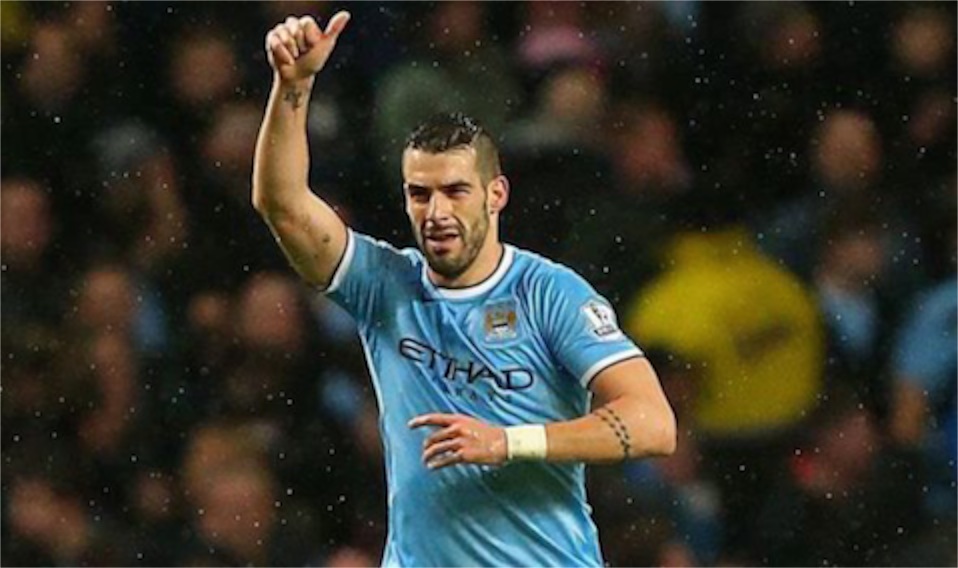
During the match we pulled out our full repertoire of songs, this is my favourite:
‘Oh Pablo Zabaleta, he is the fuckin’ man, he plays for Argentina, he’s harder than Jaap Stam. He wears the blue and white, for Pellegrini’s men, and when we win the league we’ll sing this song again’.
A little hubris at the end, possibly, but rather said with a wink. We sang songs about Kompany, Touré, Silva, Aguero, all stars of this team that we’re lucky to have. There’s still a disbelief that such talent turns out in the blue shirt. We even found time to have a little chant about one of our only good players of the 1990s (Georgi Kinkladze and Ali Benarbia are the only other good players that spring to mind of that era) – a German called Uwe Rösler (now the Wigan manager; his 13-year-old son is named Colin, after City legend Colin Bell, and he’s at the City Academy). It ends with the line: ‘Uwe’s granddad bombed the Stretford End!’ Old Trafford, you see, was bombed during the Second World War and from 1941-49, if you can believe this, United shared our ground. It might be a bit of a sad testament to the nature of football now that that would seem so unbelievable but until a few decades ago many in Manchester supported both teams. My dad’s dad, Eli, was a diehard Blue but my mum’s dad, Cyril, went to City one week and United the next. In the end, though, I like to think that his heart lay with City, as he and dad went to matches together for over a decade until he passed in 1990. Dad marvels now how he dragged himself to watch terrible football on cold, wet Manchester nights when he had a season ticket (1977-1995). As we sang the Rösler song I thought back to what seemed like only a few years ago, and how we barely had any players worth composing a song about. How on earth did this happen to us?
For my own part, I moved to London the year after we were promoted out of the old Division Three in 1999 (now called League One, and just to confuse you it was called Division One then). At that time we were playing in our charming but crumbling home since 1923 – Maine Road. My grandfather Eli, who I sadly never knew, had been to the very first match there. My father’s first game was in 1960. Mine was in 1988. It has been a long family road. A story from the 1990s goes that the Maine Road groundsman wasn’t able to even paint the white lines on the pitch without handing over cash into the hand of the local paint suppliers. That’s how broke we were. Two decades of financial mismanagement had brought the club to its knees. When I was a kid in the 80s a local businessman called Peter Swales, a diehard Blue with a spectacular comb-over, was the chairman. He was a passionate man but an utterly hopeless businessman and we lurched from one crisis to another. The fans revolted and he was ousted in 1994 and replaced as chairman by Francis Lee, a legendary former player of ours. Unlike most players of that era, who were paid little and ended up getting real jobs after their playing days were over (very few went into management and punditry as it is now didn’t exist then), he had become a successful, wealthy businessman. He had made his fortune recycling paper, primarily toilet rolls. I, literally, shit you not.
He was another terrible choice, as it turned out. Ex-players put in charge at the higher levels always want to run the team and he undermined the many managers he hired and fired. His friend, the late great Alan Ball (brilliant player, World Cup winner) was a hopeless case and relegated us in 1995. And then the managerial merry-go-round started. Let me put this into perspective with a statistic: during Sir Alex Ferguson’s Old Trafford reign of 27 years, we had (excluding Cup and League-winning captain Tony Book’s brief caretaker manager reigns) 17 managers. From August to December 1996 we had 3 managers. In 5 months. That’s what it was like in those days. We were relegated 3 times, up and down, up and down. During our tenure in the 3rd tier in 1998/99 we lost 1-0 at home to Bury. A local team now in League Two (the 4th tier) who, on average, draw 3,500 fans a home game. Even in the 3rd tier we averaged 28,000, over twice as many fans as any other club. I have several friends who are Bury fans; I tell you, they’re real fans, schlepping to watch a team that will never win anything, home and away. I was at Bury College at the time of this defeat. You can imagine what Monday morning was like.
In 1998, finally, a good man took charge and, essentially, fixed everything. He is responsible for where we are now (as is Paul Dickov, but that’s another story: this goal changed the club forever). David Bernstein (a very clever and rich man, the then-CEO of fashion retailers French Connection and an accountant by trade) was a lifelong Blue and couldn’t bear the disaster any longer. He transformed the club from the ground up, securing financing and doing the deal that got us, at a nice price thank you very much, the 2002 Commonwealth Games stadium, which we moved into the year after. Later, Bernstein was appointed as FA Chairman (he just retired – you have to at 70 – and has been replaced by the very stupid TV mogul Greg Dyke) and he just received a CBE for services to football.
But still, even then, we stumbled around for a while, though we were now financially on better footing, and were unfortunately bought by a Thai crook (a former PM and oppressor of his people, a murderer, some say) called Thaksin Shinawatra. Like many fans, I was deeply unhappy with this ownership, and it enhanced the geographical distance somehow. I felt disconnected from the team for the first time in my life and I hated it. Then, the unimaginable happened. In 2008, thanks to the beauty of the stadium apparently, the ruler of the Emirate of Abu Dhabi, Sheikh Mansour, saw us as the perfect investment. A sleeping giant, as they say. Five years later he’s spent £1 billion and transformed us into a club that can compete at, we hope, the highest level. He has hired smart football people: our Spanish lynchpins, CEO Ferran Sorriano and Director of Football Txiki Begiristain, were both, essentially, poached from Barcelona. He installed our chairman Khaldoon Al Mubarak, his main connection to the team, who visits Manchester often. Khaldoon has an American accent thanks to his degree, in finance and economics, from Tufts in Boston and is a very clever, tough but likeable man doing a spectacular job – he is supportive and does not interfere in football matters, as so very many idiotic chairmen do (central casting Disney villain Vincent Tan at Cardiff and the moronic Assem Allam at Hull, I’m looking at you). Our manager, Manuel Pellegrini, another shrewd appointment, is now giving us the stable, drama-free, leadership we need. In personality, he is everything the over-emotional, difficult, passionate and impatient Roberto Mancini was not.
Only five years ago I was going through a period of feeling totally disconnected from my team. And now, that feeling is a world away. I still can’t quite believe what’s happened.
Those players are working for me. Yes, for themselves, for the manager, for their money, but when you’re there watching a game live, you can’t help but marvel at how they’re toiling in the cold, getting kicked all over the pitch, working their backsides off, for you. For all of us. There’s a giddy glee now to City fans, after years of longing and disappointment and being kicked in the teeth. Yes, there’s still a fear, which really is unfounded, that it may all end tomorrow… but it could go on forever, as the Smiths song goes.
Nothing stays with you for life like football does. You lose jobs or move houses, or cities, and your team is still there. You lose family members and your team is still there… in my case they were able to provide a distraction during unimaginably tough times last year. I know that these men are highly paid but none of that matters during a game, when you dream and fear and wish and want and they work to try and please you. To gain your love. These men are not machines, devoid of sentiment. They were kids once, who stood on a terrace like the one you’re standing on, cheering their team, worshipping their heroes. They get to do it, for real, they get to be the guy they dreamt of being. Most people have a rather craven view of money. That it fixes everything, that it’s all that matters. I know someone who loves his team but cannot stand any football players. He says they are all yobs. He constantly talks of how they’d rather be paid a ton and sit on the bench than earn less and play every week. He cannot see their humanity. He cannot see past the 5% who are pictured with women not their wives or get into nightclub brawls. I feel sorry for him. These are human beings, with families, and they work hard every day. If anyone doubts that take a look at a feature on our website called Tunnel Cam. We are, it would seem, the only club that does it.
As an example of anthropology it is fascinating. It shows in the clearest way I have ever seen the complete mental and tonal shift that the players experience and what happens before they go over the white line. We all know what happens after. But before, players greet each other as friends, as on each team there are connections: the same nationality, a player who used to play with you at a former club, a player who you play with for a national team. It’s all cordial reunions and hugs and European cheek-kissing and shirt-swapping. Lines of mascots (kids aged between 4 and about 10 who accompany the players onto the pitch) stand in the tunnel, holding their hands out to be high-fived by the players, who are charming and kind to them. Sometimes players will have their own children as mascots. These big, tough, tattooed men, gently picking up and kissing their tiny toddlers, who are wearing matching strips to them. You’d have to have a hard heart not to be touched. It’s important to humanise players, not least because it lets you feel connected to men who, in my case, play 200 miles away from where I live. Additionally, our dual fandom is one facet of my relationship with my dad; it’s an unbreakable bond with him as much as the team.
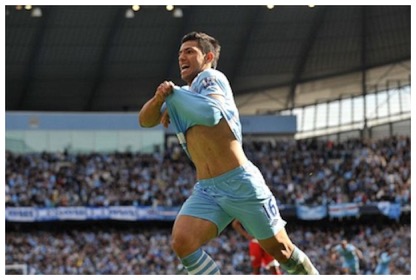

When I go to away games, I am consumed by joy, win or lose, in being able to be with my people, my fellow Mancs: in all their happy, sad, angry, thrilled, hilarious, nervous, anarchic, relieved, sometimes disappointed foul-mouthed glory. This is football. At its core, this is what it is. You belong, for life. You love them and they love you. They never leave you, and you never leave them, even if and when they let you down. At the end of the West Ham game, after 90 minutes of brilliant banter (We sang: ‘You’re getting Moyes in the morning!’ They sang: ‘We only need 10!’ (we were 3-0 up by this point, 9-0 on aggregate) and when Stevan Jovetic, a new player who has been unlucky with injury came on, we sang: ‘Who the fucking hell are you?!’) the Hammers fans did a little Poznan (our backs to the pitch, arm over arm, jumping goal celebration) and we did one back to them. Then we all did it together.
The brave, hardy Hammers were 9-0 down and those fans love their team as much today as they did yesterday, as they will tomorrow. That is football... and that used to be me. I remember one week in the early 2000s where we played Liverpool twice in a week, Cup and League. We lost 6-0 and 4-0. Times change but people do not. I’m stuck with this club for life.
When I was growing up, Manchester was a very tough place to be a City fan. In my school year, of 100+ girls, I was one of three Blues. Not everyone supported a team of course but there were probably 60 or 70 United fans. What will that number be in a decade? I see kids now at the matches who won’t remember how bad things were. Talking recently with a United fan friend, he told me I was willing to pay any price for success – meaning, in reference to our owners and where their largesse is derived from, I’m turning a blind eye to the terrible human rights conditions in Abu Dhabi in exchange for, one hopes, trophies. If I’d experienced 20+ years of unrivalled success, like he had, and my club was bought by people who treat their citizens like crap would I abandon the club? United may be owned by people sucking the financial life out of the place but at least they’re not human rights abusers. Do I turn a blind eye because I’ve toiled and loved and, through thin and thin, supported a club that let me down every week? Do I think I deserve some success now, at any cost? I wish I was stronger, and I admire people who have turned their backs on the club, in a way. They’re better people than I. Why do I continue to support a club run by people who treat women and gays and immigrant workers like shit in their own country? A regime that if City had a Jewish player he would not be allowed into the country. I cannot defend that, and thus I cannot defend myself. It’s a complicated issue and one I have no answer for. All I can say is that, in daily life, we are all complicit in demeaning others, whether we want or intend to or not. We all own clothing from sweatshops, we all buy computers (and TVs and DVD players) made by Chinese slave labour. I’m just trying to do my best, every day, like everyone else. Unless you live in a tree and wear clothes made of hemp and forage for food you’re complicit too. So I take a little bit of pleasure when I can from football, because it took and took from me for so many years and hardened me to misery and now finally I’m getting something back. What can I do about it except cut my nose off to spite my face? I’ve mostly, though not entirely, made my peace with it.
Some City fans take more pleasure in United losing than City winning. I never understood those people even when I was living in Manchester and taking shit from United fans every single day. They pitied, bullied, patronised and laughed at us. And we were pathetic – I’d be lying if I didn’t admit that it does feel a little nice that they don’t get everything their way now. But, I always say to dad – I don’t care about what other clubs do, who they play, who they lose points to; we can only control what we do, how we play, and do our best. These players are the best that City have ever had. Sometimes I can’t believe what I’m watching. It’s like a gift. Like someone decided that we’d taken enough shit one day and said: it’s your turn. I’ll take it.
Crosby, Stills and Nash :: Royal Albert Hall, London, 8-10-13/9-10-13
And so the splits went down like this: Graham Nash, from Salford, Manchester (though born in Blackpool), wrote a jaunty tune called Marrakesh Express and his band, The Hollies, hated it, which started off the trouble. I had always, somewhat unfairly, teased that Nash was a little Ringo-ish: a guy with the perfect personality who just fitted in with the more talented ones. I do find him a little cheesy, I admit, with his mid-Atlantic accent, but he’s a brilliant songwriter, with a lovely voice, and he’s even got a creditable second career, having been a digital art pioneer in the early 80s, as a rather excellent photographer. This is the man Joni wrote Blue about. There must be more to him.
David Crosby is truly one of my favourite people on earth. I met him once, at a solo show at the Jazz Café. I’d seen his former bandmate Roger McGuinn there earlier that same year, and though I’m not an autograph person, I happened to have pinched my parents’ Byrds box set and took the booklet along. Management gofers took handfuls of memorabilia, returning with signatures. McGuinn, well known as not being the nicest guy, refused to meet anyone. Crosby, on the other hand, held court in the bar upstairs, talking warmly with everyone, signing everything proffered at him. I have no recollection of my fangirl babble, but I do remember that he looked at me with the kindest face I’d ever seen, his big cheeks puffing out as he smiled, framing his magnificent white handlebar moustache. It’s what God, if he existed, should look like.
As he started to move away from the volcanic troubles in The Byrds, he found himself delving further into a hippy ideal and nowhere was that purer than, not Woodstock, at 1967’s Monterey Pop Festival. Of all of the landmark rock festivals, and there were plenty, that one, for me, is the standout. It had the best bill, the best atmosphere, no trouble, no lack of facilities and a manageable medium-sized 60,000 strong crowd (though the performance spaces only held 8,000 each, so most missed the bands; everyone was there for the vibe, man). Gene Clark had already left The Byrds by then, driven out by the stress of dealing with everyone else, McGuinn and Chris Hillman in particular. During their appearance, Crosby went off, ranting about Vietnam, and then further annoyed his bandmates by stepping in for an absent Neil Young to guest with Buffalo Springfield, at their leader Stephen Stills’ request. The cracks were there and, as these things go, it all happened pretty fast. Stephen and Graham quit, and David was fired. The three met for the first time at David’s house on one sunny Laurel Canyon day in 1968, and sang together for the first time.
Famously, Woodstock was only the second Crosby, Stills and Nash show. Neil Young, who did play with them briefly there but was too nervous to be filmed, had also jumped the Springfield ship and, of course, has been in and out of the band for many decades. But for me, it's all about the core three. The spikiness of Stills, who knows he’s the leader only when Neil’s absent, and the brotherly Crosby and Nash, who’ve made great duo records and often tour together. I’d seen them live at Glastonbury in 2009, though my overall experience that year wasn’t positive, and I remember little of their performance anyway. I got a last minute ticket from a woman called Barbara; after my failure to get Fleetwood Mac tickets the other week, it felt like I was meant to be there.
However much I thought I'd enjoy this concert, it completely exceeded my expectations. It was a 3-hour odyssey through some of the best songwriting of the last half-century. Crosby is now 72, Stills is 68 and Nash is 71. It’s dull to talk about ageing rock stars. There are no ageing painters or playwrights. There’s no need to be shocked when, despite grey hair and slightly wider waistbands, a band like this are in great shape. It’s what they do, what they’ve always done. They’re touring, hardened musicians who have been playing live for almost 50 years. Their energy does not flag, while new songs are numerous and hit the mark. ‘These new songs stop us from being The Eagles’, Graham quipped. One must admire their bullish insistence on playing several new compositions every night; as we know, many of their contemporaries don’t bother, either because of fear of clearing the venue or because the creative wellspring ran dry long ago. Nobody leaves for a loo/pint break during these new songs, like you usually see at gigs like this. And by ‘like this’ I mean the nonsensical concept of oldie or nostalgia acts. Get on, play the hits, the tickets are expensive, I want to get home before 11, the crowd think. A venue’s size at this level can, I think, influence the setlist, the choices made. At the Royal Albert Hall, which seats a crowd of around 4500, there was an undeniable emotional intimacy. Playing in a ‘small’ venue (as opposed to, say Wembley Arena or the O2) lets them indulge themselves a little more, maybe playing a more varied setlist. Perhaps it felt so intimate because I had seats on the surprisingly cosy floor. They made it feel like a living room.
This band have survived it all. Coked-up 70s madness, death (Crosby’s girlfriend Christine Hinton was killed in a car accident, which it’s been said he’s never recovered from, though he has been evened out by Jan, his wife of 36 years), fighting (you sense Neil vs. Stephen was the main attraction), a couple of overdoses (Stills, in the 70s), and yet they kept getting drawn back together. From the opening chords of Carry On , from 1970’s Déjà Vu, this was such a special night. Those three voices soared, backed ably by a brilliant band: Todd Caldwell, organ; Shane Fontayne, guitar; Steve DiStanislao, drums (superb!); Kevin McCormick, bass, and James Raymond (Crosby’s son) on keyboards.
There’s something about the beauty of vocal harmonies at this level (there’s little, Beach Boys aside, this good) that always gets me. In particular, David and Graham’s voices ache with exquisite sympatico. The tempo never dropped, incredible pop songs just kept on coming: Almost Cut My Hair (a Crosby tour-de-force), Buffalo Springfield song Bluebird, performed without C&N, which brought a rapturous ovation following fiery guitar work, Long Time Gone (used in the opening scene of Woodstock of course), the perfect pop of Nash’s Military Madness, it was endless. Cathedral was prefaced by his tale of its creation, “One day I decided to get up really early, take acid, rent a Rolls Royce, and go to Stonehenge. In those days you could touch the stones. I lay on the ground for a thousand years, or it could have been 10 seconds, I couldn’t tell. I walked to Winchester Cathedral, and found myself chilled to the bone as I stood on the grave of a soldier who had died in 1799, but on my birthday.” The RAH’s newly restored pipe organ was bathed in red light and its tones filled the room (though it was begging for a Spinal Tap papier-mâché model to descend). Before the sweet tale of domesticity that is Our House (which has had a second life as an accompaniment to various TV adverts), he started off by talking about Joni. One day they went out shopping and she saw this nice little vase, which he encouraged her to buy. When they got home, he said ‘I’ll light the fire, you put the flowers in the vase that you bought today.” The crowd broke into warm applause, recognising that simple post-shopping trip sentence as the first lyric couplet.
It went on: Helplessly Hoping, and its perfect harmonies, brought tears to the eyes, Crosby’s signature love song Guinnevere, Déjà Vu, Southern Cross, the magnificent Wooden Ships and, of course, Suite: Judy Blue Eyes. New songs and old, mountains of charm and passion, the kind of togetherness you feel lucky to witness, from men who’ve been through everything together, through rain and shine. I was overcome, by history, songwriting, guitar playing that’s hardly done like that anymore, and that sweet trio of voices. Unforgettable night. Graham’s hometown show in Manchester happens on Saturday, I envy my dad that he’ll see this remarkable band (for the first time: he’s seen solo Stills, CSNY and C&N, but never just all three).
_______________________________
I’ve just made an offer on Scarlet Mist for a ticket for tonight’s show. Bonkers, you may say, but if a chance is in front of you, take it without regret.
Incidentally, it seems to be considered odd to see multiple gigs on one tour. Few understand why I’ve done it so often. It’s normal to see the same band a year apart, on the next tour, but strange to see them a day apart? In all honesty, I haven’t felt like this for 18 months. I’ve enjoyed the gigs I’ve attended, but last night felt like something old was coming back, some spark of joy in myself that had been lost. It’s a tiny step, but nevertheless, it feels very real. That’s why I’m going again. More to come…
___________________________________
So, the second show. An even better seat this time, giving me a new angle, letting me see details previously invisible. Graham Nash performs barefoot, who knew? The stage is festooned with rugs and a couple of scarves. The interplay is much clearer second time around. You can still see, even now, the divisions between Stills and the others. I wonder if he’s jealous of their brotherhood? Maybe. I do think he’s bemused and annoyed by not being Neil Young. You get the sense he can’t believe he’s not playing arenas by himself whereas the other two don’t care at all, they’re just happy to be performing. A passage in Nash’s autobiography sums up the differing vibes, the personalities, of his bandmates: “I had never met anybody like Crosby. He was an irreverent, funny, brilliant hedonist who had been thrown out of The Byrds the previous year. He always had the best drugs, the most beautiful women, and they were always naked. Stephen was a guy in a similar mould. He was brash, egotistical, opinionated, provocative, volatile, temperamental, and so talented. A very complex cat, and a little crazy.”
Graham, though it pains me to praise a United fan, is very charming. Joni’s famous quote about free love (what bullshit it was, how it was only good for men) was, I suspect, said with him in mind. She’s the one that got away, certainly, but his wandering eye paid to that, though initially she had tracked him down and seduced him. You constantly hear ‘hey, it was the 60s/70s!’ to excuse a lot of misogynist behaviour. Not that times and the perception of morals weren’t different then. Joni had had a brief fling with Crosby, who wasn’t the possessive type and was cool when she invited Graham to live with her on his first day in LA. Indeed, he later shared one of his other girlfriends with Nash, who stole Rita Coolidge from Stills, who had a long relationship with Judy Collins and so on and on. But the machinations and treatment of women in the 1970s is a subject for another day…
I enjoyed the second gig just as much as the first, undoubtedly. It was another intimate, emotional night, which made the venue seem small. It was fun, as it always is, to watch middle-aged, middle-class, white people try to let go. A foot tap, a head bob, polite applause for Stills’ guitar virtuosity… English people are so tightly wound sometimes. Particular treats were To The Last Whale, from Wind On The Water, Crosby & Nash’s 2nd album, and a magnificent version of Triad, David’s odd yet sweet invocation of the benefits of threesomes. He’d written it during his time in The Byrds but McGuinn rejected it, horrified. Jefferson Airplane were not so squeamish and took it on, covering it on their album Crown Of Creation. Again, the S-only (no C&N) version of Buffalo Springfield’s Bluebird just blew me away. I closed my eyes and, during the free psychedelic blues jam freakout of its second half, was simply transported to another place entirely.
It’s hard to put your finger on what keeps this band together, given their histories of bickering and drug trouble. I can only surmise that it’s just pure chemistry, the non-narcotic kind, because when you watch them live it’s a magical experience. They know it, from first note to last: that they are greater together than apart. It’s all about those hugely different voices. The high notes left Stephen long ago, but a gravelly tone serves him so well, despite the odd note missed. Amazingly, Graham can still sing in a nicely high register, which is particularly welcome and surprising. Perhaps David’s voice is the strongest individually, which considering he’s been through decades of drug addiction, culminating most spectacularly in a spell in prison in the early 80s, almost feels shocking. It’s like watching Keith Richards’ gnarled, deformed, arthritic hands play a perfect solo during Sympathy For The Devil. It makes no sense but there it is, your eyes and ears don’t lie. He’s got the same childlike joy as Keith has; he’s a survivor who’s just happy, and genuinely surprised, to be alive. The harmonies might not hit the same high notes they used to but during Helplessly Hoping it was like time stood still, I’ve never heard voices so sweet. Even in lower tones, it was remarkable to witness. As the band left the stage and I took a deep happy breath, the tannoy led the crowd out with refrains of We’ll Meet Again. I hope so.
Carry On/Questions (CSNY)
Pre-Road Downs
Long Time Gone
Just a Song Before I Go
Southern Cross
Marrakesh Express (night 1 only)
Lay Me Down (C&N)
Military Madness (night 1 only)
Time I Have
Cathedral
Bluebird (Buffalo Springfield)
Déjà Vu (CSNY)
49 Bye-Byes
Set 2
Helplessly Hoping
Teach Your Children (CSNY)
Treetop Flyer (Stephen Stills song)
Golden Days (2nd night only)
What Are Their Names
Guinnevere
Burning for the Buddha
Triad (Jefferson Airplane cover)
Critical Mass/Wind On The Water (2nd night only)
Our House
Almost Cut My Hair (CSNY)
Wooden Ships
Encore:
Suite: Judy Blue Eyes
_____________________________
Addendum:
Dad’s report – amazing, emotional show. Judy Blue Eyes was not played (they ran over the curfew I suspect). Graham dedicated a song to his sister and her family, who were present. David said ‘I have so much to thank Manchester for; you gave me my best friend in life.’
Dad wanted to add to this the story of how he ignored Joni Mitchell. In early 1970 he was working in Burtons, a men’s clothes store on Deansgate in Manchester. A crowd of four came in and he immediately recognised one as Graham Nash. He ran up to him and engaged him in conversation, and they chatted for a while. He told Graham he’d just bought the first Santana album and loved it, to which Graham replied that they’d just played a gig with them in New York. They talked about music, and Graham bought a sheepskin coat for his step-dad. What a trip, right? A few weeks later a colleague said ‘wasn’t that amazing, when he came in with Joni Mitchell’. The blood drained from dad’s face.
The three women had been Graham’s mother, sister and girlfriend. He had ignored her completely, so wrapped up was he in talking music. He later wrote to MOJO, apologising to Joni for ignoring her, as she was the love of his life, adding ‘don’t worry, my wife knows about that!’
...